


Adjusting length for armhole edges
So you’ve found a set-in sleeve pattern you love and want to knit. You have even taken the time to measure your armhole depth to achieve a perfect fit.
What if the pattern was not designed with the armhole depth you want? Or if you are taller/shorter than average? Or (one of the most common problems we find amongst our customers) you are achieving stitch gauge, but your row gauge is bigger/smaller than that in the pattern?
If any of these describe you, then this mod might be for you.

What's in an armhole measurement?
Knitwear design pattern schematics featuring a set-in sleeve construction - similarly, saddle and contiguous shoulder constructions - will often provide the knitter with an armhole depth measurement. Though these depth measurements may vary for a variety of reasons from the size chart the designer uses to grade their patterns, to the ease built into the pattern for aesthetics purposes, we strongly prefer having at least 1" / 2.5 cm of positive ease so we can move around and be active.
However, not every body fits neatly into a size chart. If you are extra tall, or have a long upper torso, you may need to lengthen. If you are petite, you may need to shorten.
By comparing your body measurements to the measurements given in the pattern, you can understand how much ease, or extra fabric, there will be in this measurement and make a decision on whether you need to lengthen or shorten it.
Once you have this measurement handy, and you know what your preferred armhole depth is, you're in good shape to start modifying.
And even with all of this information handy, sometimes your row gauge may not fit the one outlined in the pattern. This can be a simple fix for a section of the pattern that asks you to knit to length. But areas where there is shaping involved such as the upper torso, a bigger or smaller row gauge can lead to an armhole that is too long or short.
Armhole depth knitting adjustment
Deciding How Much to Add/Remove
First, you'll need to convert the measurement you want to add or remove (say, 1" / 2.5 cm) to the row gauge. Once you know how many rows that you'll need to add on the armhole edge, you can then proceed to figure out where the best places are to add it.
Determine the Placement
To shorten or lengthen armhole depth, you’ll want to make sure you’re adding or removing length in the most optimal places. In other words, you will want to make these adjustments where they don’t interfere with the overall shaping of the neckline or armhole.
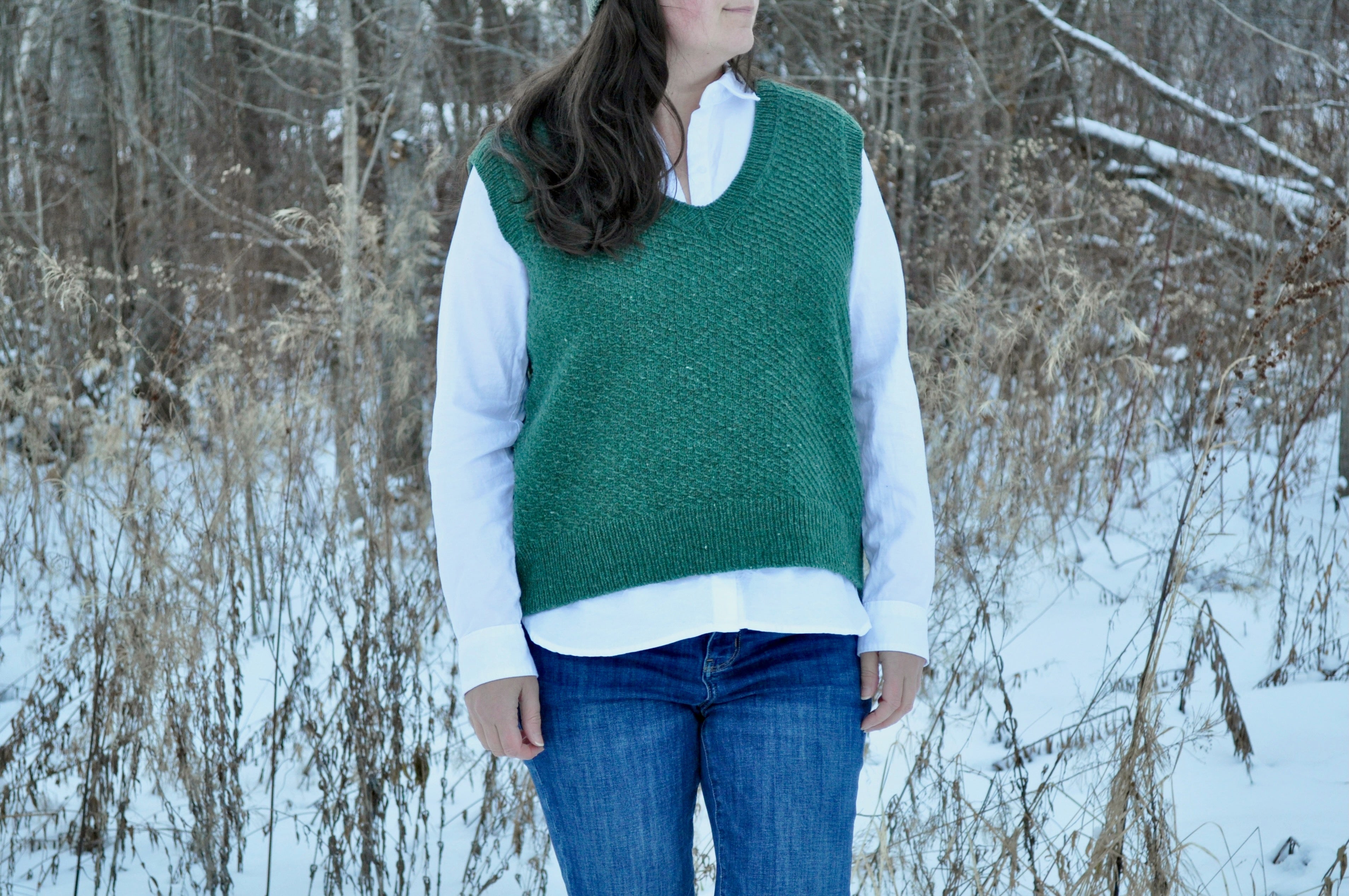
Knowing this is a common adjustment among knitters when it comes to row gauge discrepancies, we have even taken steps to outline the best places to shorten and lengthen armhole depth in our most recent pattern release, the Reading Room Slipover.

Shortening Armhole Depth
In crew neck patterns, or the back section of a knitting pattern, which require you to work even for a particular number of rows to achieve the armhole depth, you will simply work fewer rows during your "work even" sections to shorten the length.
In v-neck patterns, it is common to work shaping more gradually at the upper section of the V and more rapidly at the lower section. You will remove “work even” rows in the upper section of the neck shaping.
For example, many patterns will have you work shaping every other RS/WS row (every 4th row) in the upper section of the “V” and every RS/WS row (every 2nd row) in the lower section of the v-neck shaping. Rather than working your shaping every 4th row, you will omit a few pairs of rows and work your shaping every RS/WS row more often.
Lengthening Armhole Depth
Just like with shortening armholes in crew neck patterns, or the back section of a knitting pattern, which require you to work even for a particular number of rows to achieve the armhole depth, you will simply work more rows to lengthen it.
In v-neck patterns, you will want to perform the opposite from above and add “work even” rows in the lower section of the neck shaping.
In other words, when the pattern indicates you should work shaping every other RS/WS row, you will instead work the shaping every 4th row to add length in pairs of rows.
Shortening and lengthening in practice
In practice, when you shorten or lengthen, the end of your shaping might look something like this chart below:
|
Without Adjustment |
Shorten |
Lengthen |
|
|
27 |
Increase |
Increase |
Increase |
|
28 |
|||
|
29 |
Increase |
||
|
30 |
|||
|
31 |
Increase |
Increase |
Increase |
|
32 |
|||
|
33 |
Increase |
||
|
34 |
|||
|
35 |
Increase |
Increase |
Increase |
|
36 |
|||
|
37 |
Increase |
Increase |
|
|
38 |
|||
|
39 |
Increase |
Increase |
Increase |
|
40 |
Finished |
||
|
41 |
Increase |
||
|
42 |
|||
|
43 |
Increase |
Increase |
|
|
Finished |
|||
|
Increase |
|||
|
Increase |
|||
|
Finished |
|||
In each instance we have made a 4 row adjustment leading to a shorter or longer armhole depth.
As you can see, mapping out your increases and decreases row by row can really help you visualize the most pleasing curve.
Finally...
Finally, don't forget to account for yardage if you are adding any kind of length, and double check that you have the right number of increases throughout the yoke so that you still end up with the intended ease in the body.
We hope that this post was helpful to you in understanding how armhole length modifications work! Happy knitting!
If you're looking for more great tips for fitting a hand knit sweater, here are some articles you might find helpful:


Leave a comment
This site is protected by hCaptcha and the hCaptcha Privacy Policy and Terms of Service apply.